Software product development · Grendon Underwood, Buckinghamshire

Build the right thing next.

WHATNXT develops software products for businesses that have more ideas than time. We help you work out which one deserves building, prove it cheaply, then make it properly and keep it moving after launch.

Illustrative collage of paper prototypes, arrows and cards connected with string on a plum surface
Illustrative image, generated for this site

the problem we are for

Too many good ideas, one development budget.

Most software is not built badly; it is built in the wrong order. A team spends four months on a reporting module nobody opens while the thing customers ask for every week sits in a backlog. We exist to stop that happening.

WHATNXT is a software product development company. That means we do the whole job, not just the typing: understanding the people who will use a product, choosing what to make first, designing the screens, writing and testing the code, releasing it, and then deciding with you what to do with what we learn. The name is the method. At every stage we ask what should happen next, and we make that answer explicit rather than letting momentum decide.

Our clients are British businesses that need a product of their own: an internal tool that replaces a fragile spreadsheet, a customer-facing web application, a mobile companion to a service they already sell, or the next version of something that has outgrown its first build.

what we build

Four shapes of product work.

New products from a blank page

You have a problem worth solving and a sense of who has it. We turn that into a narrow first release that real people can use, usually a web application with the account, data and admin pieces it genuinely needs and nothing it does not. You own the code and the decisions behind it.

How new builds work

Internal tools

Booking boards, approval flows, job trackers, stock views: the software your own team uses all day. Often the brief is to replace a spreadsheet that has quietly become a database.

The next version

A product exists and works, but the next step is unclear. We review what is there, talk to the people using it, and plan the changes that unlock the most.

Prototypes that answer one question

Sometimes the right thing to build is a throwaway: a clickable sketch to test whether customers understand an offer, or a technical spike to find out whether two systems can talk. We label these honestly so nobody mistakes them for finished software, and we tell you plainly what each one proved and what it did not.

the loop

Ask, sketch, build, ship, learn. Repeat on purpose.

  1. AskShort conversations with the people who will use the product and the people who will pay for it. We write down what we heard, not what we hoped to hear.
  2. SketchRough screens and flows, tested on a few intended users before any production code exists. Cheap to change, so we change them often.
  3. BuildWorking software in small increments, each one reviewable. You see progress in a real browser, not in a status report.
  4. ShipReleases go to real users as early as is safe, sometimes to a small group first, with a plan for undoing a release if it misbehaves.
  5. LearnWe look at what people actually did and agree the next question. Sometimes that means building more; sometimes it means removing something.

the exchange

What you bring. What you leave with.

You bring

  • The problem in your own words, including the messy parts
  • Access to a handful of people who will use the product
  • Someone who can make decisions within a day or two
  • Existing material: spreadsheets, screenshots, earlier attempts
  • An honest view of budget and the date that actually matters

You leave with

  • A written product brief that names who it is for and what it will not do
  • Tested sketches of the key journeys
  • Working software in a code repository you control
  • Release notes and a short handover guide for each release
  • A ranked list of what to build next, with the reasons

Feature bet scorer Illustrative

List candidate features. Rate reach (how many users meet it, 1–5), value (how much it matters to them, 1–5), your confidence in those guesses (per cent) and effort (1–5). The ranking divides expected value by effort.

FeatureReachValueConfidence %EffortRemove

try it here

Rank your next feature in two minutes.

Edit the examples, or replace them with your own ideas. The scorer runs entirely in your browser.

It is a simplified version of the reach, value, confidence and effort scoring that many product teams use. We use it at the start of discovery, not as a verdict but to expose disagreements: if two people rate the same feature very differently, that is the conversation worth having. Two more instruments, a first-release slicer and an assumption sorter, are on the tools page.

hard calls

Decisions we will make with you, not for you.

Product development is a long chain of trade-offs. These come up in nearly every project, and we would rather discuss them in week one than discover them in month four.

Web application, mobile app, or both?

Most first releases are better as a responsive web application: one codebase, instant updates, nothing to install. A native mobile app earns its cost when people need offline use, device features such as the camera in a demanding way, or daily habit on a phone. We will tell you which side of that line your idea sits on and why.

Build it, or use something that already exists?

If an off-the-shelf product does eighty per cent of the job, paying us to rebuild it is rarely wise. We will say so. Custom software makes sense where the way you work is genuinely different, or where the product itself is what you sell.

How polished does the first release need to be?

Polish where people form trust, such as sign-up, payment and anything touching their data. Plainness elsewhere. A first release should be reliable and clear before it is beautiful.

Who owns the code and the accounts?

You do. Repositories, hosting accounts and domain names should be registered to your organisation from the start, with us added as collaborators. That keeps you free to continue with us, with another team, or in-house.

When do we stop adding features?

When the next feature would not change a decision anyone is waiting to make. We set a measurable aim for each release so the answer is a fact, not a mood.

straight answers

What WHATNXT does not do.

Being clear about edges saves everybody time.

  • Pretend a guess is a fixed price. We estimate in ranges and narrow them as discovery removes unknowns.
  • Run your infrastructure round the clock. We set up sensible hosting and alerting, but we are not a 24-hour operations centre.
  • Give legal, financial or regulatory advice. If your product touches regulated activity, you will need the relevant specialists alongside us.
  • Build features to fill a timesheet. If the evidence says stop, we will recommend stopping.
  • Hide work in progress. You can see the working software at any point, rough edges and all.
  • Lock you in. No proprietary framework of ours sits between you and your own product.

delivery standards

The rules we hold ourselves to.

01

Every change is reviewed

No code reaches your users without a second pair of eyes and an automated test run. Small changes, reviewed often, are cheaper than big ones reviewed once.

02

Accessible by default

Keyboard use, readable contrast, sensible headings and form labels are part of the definition of done, not an extra.

03

Personal data kept to the minimum

We design products to collect only what they need and to make deletion straightforward. You remain the controller of your users' data.

04

Written decisions

Why a feature was cut, why a library was chosen: short notes in the repository so a future developer is not left guessing.

05

Releases you can undo

Each release has a rollback plan. If something goes wrong on a Friday afternoon, the fix is a known step, not a scramble.

06

Outcomes over output

We report what changed for users, not how many tickets were closed. If nothing changed, we say so and adjust.

the first month

How an engagement usually begins.

Every product is different, but the opening rhythm is reassuringly similar. Scroll sideways through a typical first four weeks.

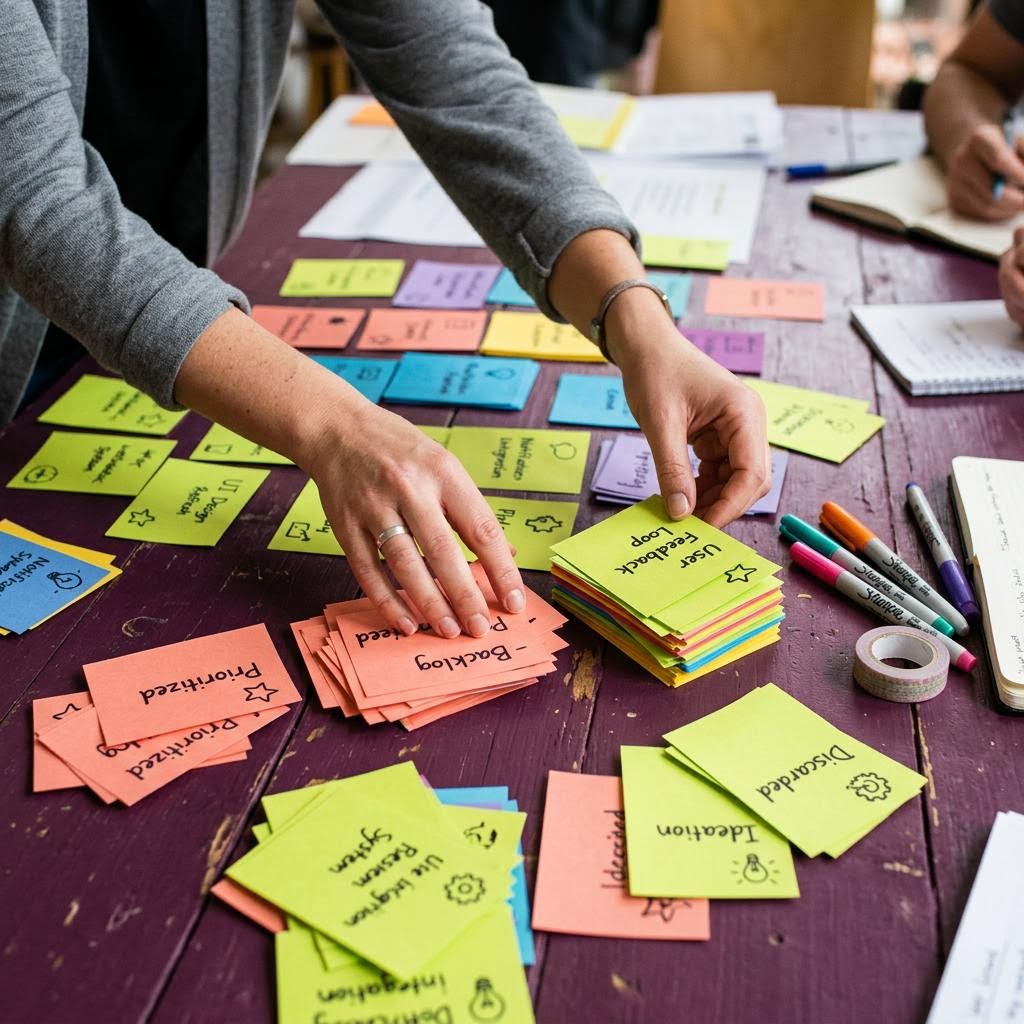
Illustrative overhead view of hands sorting coloured feature cards on a plum table
Illustrative image, generated for this site.

Days 1–3

Listen

A working session on the problem, the people and the constraints. We leave with a list of questions and who can answer them.

Week 1

Talk to users

Five to eight short interviews or observation sessions, arranged by you, run by us.

Week 2

Sketch and test

Clickable sketches of the core journey, tested and revised at least twice.

Week 3

Shape the release

A first-release scope with a range estimate, a technical approach and the risks we still see.

Week 4

Decide

You choose: build, adjust, or stop. Stopping here is a perfectly good outcome if the evidence points that way.

common questions

Before you write to us.

Do you work with organisations outside Buckinghamshire?

Yes. The registered office is in Grendon Underwood, but product work is done remotely with clients anywhere in the UK. Workshops in person can be arranged where they help.

How much does a product cost?

It depends almost entirely on scope, which is why discovery comes first. After discovery you receive a range for the first release and the assumptions behind it, so you can see what would push it up or down.

Can you take over code someone else wrote?

Often, yes. We start with a short review to understand its condition and tell you honestly whether continuing, refactoring or rebuilding parts makes sense.

What happens after launch?

Most clients continue in short cycles of improvement. Support arrangements are agreed per project; the support page explains how requests are handled.

So, what next?

Tell us the question your business is stuck on. A paragraph is enough; we will reply within two working days with either some first thoughts or an honest "this is not for us".

Write the brief

WHATNXT LIMITED

Company number 17554625
Shakespeare Barn Main Street, Grendon Underwood, Aylesbury, England, HP18 0ST

innovation@whatnxtlimited.link
Monday–Friday 09:00–18:00, UK time